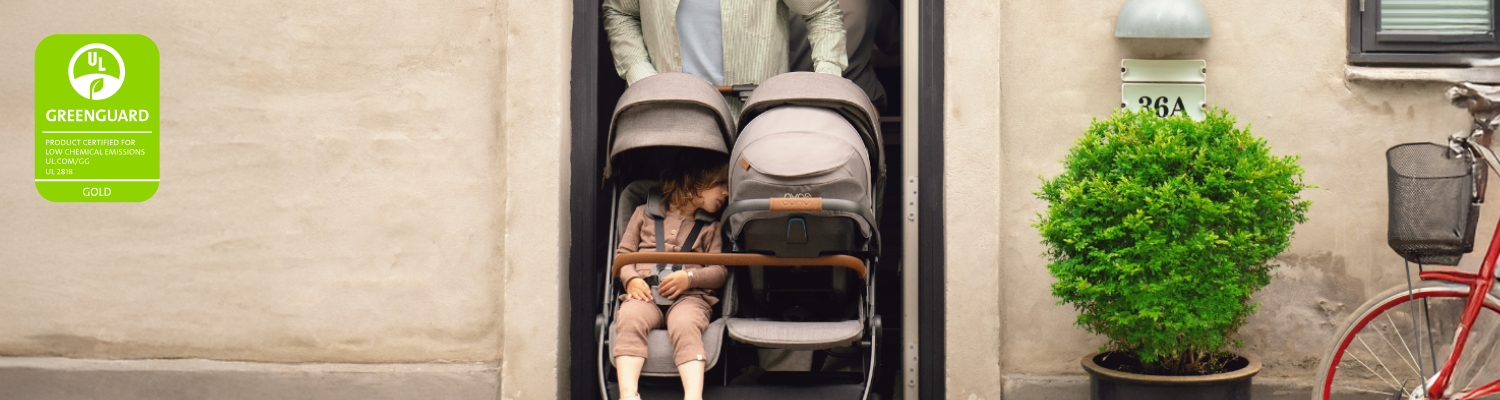
Produtos certificados pela Greenguard
Every product in this collection holds GREENGUARD Gold Certification, the strictest third-party standard for chemical emissions in indoor environments. That means the crib your newborn sleeps in, the stroller they nap in, and the glider you'll log thousands of hours in have all been tested for over 10,000 volatile organic compounds. Cleaner air in the nursery, fewer trade-offs on the brands you actually want.
Bambi Baby stocks GREENGUARD Gold pieces from the European and design-led labels parents ask for by name: UPPAbaby, Nuna, CYBEX, Bugaboo, Stokke, and more. The certification sits alongside the specs that already matter to you, side-impact protection, organic textiles, FSC-certified wood, low-VOC finishes, so safety and design read as one decision instead of two.
What's inside the collection
The range spans the full nursery and on-the-go setup, so you can build a low-emission home without piecing it together from ten different retailers.
- Nursery furniture: convertible cribs, double dressers, hutches, changing toppers, toddler rails, and bed conversion rails, plus complete nursery sets that grow from infancy through the toddler years.
- Sleep: bassinets that meet GREENGUARD Gold limits on chemical emissions, ready for the first months in your room.
- Strollers: single strollers, travel strollers, double strollers, and single-to-double strollers for growing families, plus stroller organizers.
- Car seats and travel: infant car seats, convertible car seats, and full travel systems that pair stroller and seat in one certified package.
- Daily essentials: bouncers and playards for the floor-time setup most apartments need.
Why GREENGUARD Gold matters in a nursery
Newborns breathe roughly twice as fast as adults and spend up to 16 hours a day asleep, much of it inches from the surfaces around them. GREENGUARD Gold sets emission limits specifically calibrated for sensitive populations, including children and people in healthcare environments. A crib or glider that carries the mark has been tested in a chamber, not just designed with good intentions.
For parents furnishing a small city nursery, this matters more, less square footage means higher concentrations of anything a product off-gases. Choosing certified pieces is one of the few air-quality decisions you can make once and stop thinking about.
How to shop the collection
Most parents start with the crib and the car seat, the two pieces with the longest daily contact. From there, the mattress and glider tend to follow, then dressers and changing toppers. If you're pairing certified furniture with a certified seating spot, our GREENGUARD gliders and motorized nursery gliders sit in this same standard.
Frequently asked questions
What does GREENGUARD Gold Certified actually test for?
Independent lab testing screens products for emissions of more than 10,000 chemicals, including formaldehyde, phthalates, and total VOCs. Gold-level limits are stricter than the standard GREENGUARD tier and are set for use by infants and children.
Is GREENGUARD the same as organic or non-toxic?
No. GREENGUARD measures what a finished product releases into the air. Organic refers to how raw materials are grown. Many products in this collection are both, organic cotton textiles on a GREENGUARD Gold-certified frame, for example, but the two certifications answer different questions.
Are GREENGUARD Gold cribs safe for newborns from day one?
Yes. Every crib here meets U.S. CPSC safety standards in addition to the GREENGUARD Gold emissions standard, and is suitable from birth when paired with a firm, flat, tight-fitting mattress.
Do GREENGUARD car seats and strollers offer the same safety features as non-certified versions?
Yes. Certification is additive. A GREENGUARD Gold convertible car seat still meets FMVSS 213 federal crash standards and carries the same brand-specific side-impact and harness technology as the rest of the line.
Why are GREENGUARD Gold products often more expensive?
Certification requires ongoing third-party testing, lower-emission materials, and reformulated finishes. The cost reflects the testing program and the material substitutions, not a markup on the label itself.